About FLOW TABLE Hand Operated
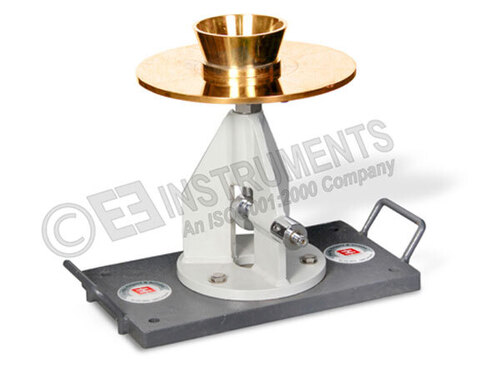
The flow table consists of a brass table top mounted on a rigid stand. The table top is reinforced with equally disposed ribs and allowed to drop through 12 mm by a ground and hardened cam, Complete with mould - 100 mm base dia, 70 mm top dia and 50 mm high.
Further details availableon our website.
The Price mentioned here are subject to change as per the capacity,specifications and application of the user.
Precision and DurabilityConstructed from robust cast iron with a machined finish and corrosion-resistant coating, the Flow Table ensures longevity and repeatable accuracy. The engraved concentric circles on the table surface aid in exact measurement, while the sturdy manual lever mechanism delivers controlled and consistent drops, conforming to standardized test requirements.
User-Friendly OperationThe table is designed for manual operation, featuring a cam-lifted lever and easy-to-read graduated scale. Level adjustment is simple with integrated leveling screws, and the equipment can be operated without any external power supply. Its compact design makes it ideal for tabletop use in various laboratory and field environments.
Comprehensive Accessories and PackingThe Flow Table is supplied with an optional brass mould and tamping bar for complete testing needs. All components are securely packed in an export-worthy wooden box, ensuring safe transportation and handling. The tables blue/black finish offers both a professional appearance and added protection against wear.
FAQs of FLOW TABLE Hand Operated:
Q: How is the FLOW TABLE Hand Operated used for testing cement paste or mortar?
A: The table is used to determine the flow of cement paste or mortar by placing a standard specimen on the table, then raising and dropping the table 15 times using the hand lever and cam mechanism. The spread of the material is measured on the engraved concentric circles, following IS: 5512/1976 specifications.
Q: What are the benefits of the cast iron table with a corrosion-resistant finish?
A: A cast iron table provides strength and stability, essential for repeated testing. The corrosion-resistant finish extends the lifetime of the table, making it suitable for use in harsh laboratory environments and ensuring measurement accuracy over time.
Q: When should manual flow table tests be performed during construction projects?
A: Manual flow table tests should be conducted when evaluating the workability and uniformity of cement pastes or mortars, especially for quality control purposes in laboratory or field settings, and during compliance checks with IS: 5512/1976 standards.
Q: Where can the Hand Operated Flow Table be set up for use?
A: This table-top equipment can be used in laboratories, construction sites, cement factories, or research institutionsanywhere standardized flow tests are required. Its compact size and durable packing make it suitable for both stationary and mobile labs.
Q: What is the process for adjusting the level of the flow table during setup?
A: The table features leveling screws on its base. To ensure accurate test results, these screws are adjusted until the tables surface is perfectly horizontal before placing any specimen and beginning the test procedure.
Q: What accessories are supplied with the FLOW TABLE and are they necessary for testing?
A: Optional accessories such as a brass mould and tamping bar are available to facilitate standard specimen preparation, improving consistency and compliance with test protocols. These tools enhance ease of use and help achieve precise results.
Q: What is the measuring range of the Flow Table and how is accuracy maintained?
A: The tables measuring range is up to 300 mm in diameter, with measurements displayed on an engraved graduated scale offering 1 mm resolution. Adherence to IS: 5512/1976, coupled with immediate manual response and stable construction, ensures continued accuracy.
 Call Us : 08045477242









 Send Inquiry

 Send Inquiry
 Send Inquiry
 Send SMS
 Call Me Free