Heat Of Hydration Apparatus About
Application
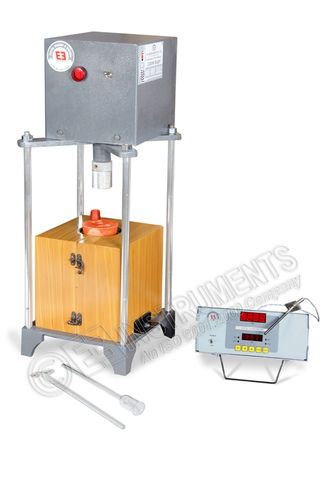
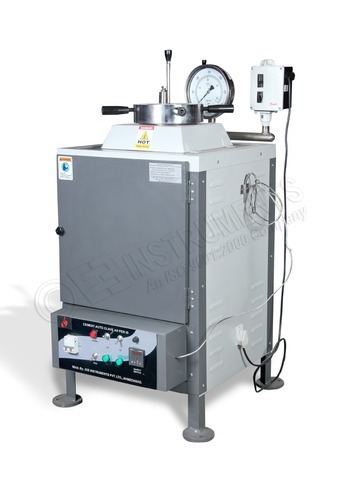
Used to determine the heat of hydration of low heat Portland and hydraulic cement. The instrument is used for determining heat of hydration of cement by measuring difference between heat of solution of dry cement and heat of solution of a separate sample partially heated for 7 days and 28 days.
Apparatus Details
- The entire assembly of Heat of Hydration apparatus consists of a Digital Beckman Thermometer, a open mouthed thermos flask, insulating material, container, hinge, stirring motor, glass stirring rod, cork stopper and glass funnel.
- Dewar flask is contained in an insulated material and housed in a wooden box, which is hinged, so that the flask can be easily removed or replaced.
- Constant speed stirrer maintains uniform temperature throughout the stirring liquid and supplied sufficient agitation to keep solid reactant suspended in the acid mixture.
Further details available on our website.
The Price mentioned here are subject to change as per the capacity,specifications and application of the user.
Advanced Heat Measurement DesignThis apparatus integrates a highly conductive copper calorimeter enclosed in a double-walled, insulated stainless steel body, ensuring exceptional precision by minimizing heat loss. The water bath incorporates a constant temperature arrangement, maintaining the desired ambient conditions throughout the test cycle. The robust construction guarantees long service life and reliable performance under frequent usage in laboratory and industrial environments.
User-Oriented Testing and ControlsFeaturing easy manual operation, the device allows thorough temperature monitoring with either a digital or mercury-in-glass thermometer (resolution 0.1C), ensuring results with high accuracy (0.5C). The insulated brass stirrer ensures uniform mixing of specimen and water, maximizing data consistency. Its tabletop installation makes it compact and convenient to set up in any standard cement testing laboratory.
Compliance and VersatilityEngineered to meet IS:11262 and ASTM C186 standards, the apparatus is suitable for a variety of cement types, especially low heat Portland and hydraulic cement. It is supplied with guidelines for proper specimen preparation and test procedures as per industry standards, making it adaptable for quality control, educational, and research purposes.
FAQs of Heat Of Hydration Apparatus:
Q: How does the Heat of Hydration Apparatus ensure accurate temperature measurement?
A: The apparatus uses a copper calorimeter for high thermal conductivity and features double-walled stainless steel insulation to minimize heat loss. It also includes a precise thermometer (digital or mercury) with a resolution of 0.1C and an accuracy of 0.5C, supporting reliable heat measurement results.
Q: What is the recommended process for preparing a cement sample for testing?
A: Sample preparation follows IS:11262 or ASTM C186 standards, using 450 gm of cement with a 0.5 water-cement ratio. The mixture is thoroughly stirred with the insulated brass stirrer to ensure uniform consistency before starting the heat of hydration test.
Q: When should this apparatus be used in cement testing?
A: This equipment is typically used during quality control and research when there is a need to evaluate the heat evolution characteristics of low heat Portland or hydraulic cement, either for initial qualification or periodic assessment in compliance with applicable standards.
Q: Where is the Heat of Hydration Apparatus most effectively utilized?
A: It is best suited for laboratory settings in cement manufacturing plants, research institutions, and materials testing agencies where precise and standardized testing is required for cement properties.
Q: What are the benefits of using a constant temperature water bath in the apparatus?
A: The constant temperature water bath controls ambient conditions during the test, ensuring that external temperature fluctuations do not affect the calorimetric measurement. This contributes to more accurate and reproducible test results.
Q: How is the temperature monitored during a test cycle?
A: Temperature is monitored manually using either a mercury-in-glass or a digital thermometer installed in the calorimeter. The operator tracks the temperature rise, typically up to 60C, within 2 minutes of thermal equilibrium, as required by the test method.
Q: What advantages does the robust construction offer?
A: The use of corrosion-resistant polished stainless steel for the outer body and copper for the calorimeter provides durability, minimizes maintenance requirements, and enables repeated testing without performance degradation.
 Call Us : 08045477242










 Send Inquiry

 Send Inquiry
 Send Inquiry
 Send SMS
 Call Me Free