Southard Viscometer About
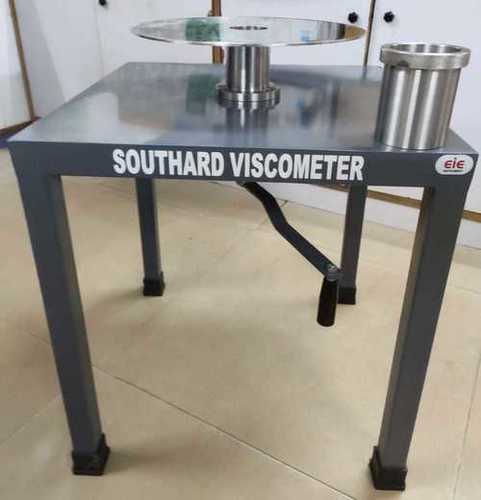
Southard Viscometer, manufactured, supplied and exported by us is provided with lime putty consistency. It can be effortlessly adjusted with ease. This is designed for a simple degree measurement and allows for simple installation and maintenance. Southard Viscometer Southard Viscometer is capable to measure the lime putty density vessel. It provides high output rate and provides exceptional performance in various applications. The said instrument can measure the precise viscosities for different fluids. This is a small &transferrable instrument, which is featured with capillary tubes.
Furtherdetails available on our website.
The Price mentioned here are subject to change as per the capacity,specifications and application of the user.
High-Performance Cement Consistency TestingEngineered to facilitate reliable adjustment of putty and cement consistency, the Southard Viscometer employs a manual discharge mechanism for direct measurement. Its stainless steel body and polished finish ensure long-lasting utility and resistance to corrosion, while the devices portability enables use both in laboratory and on-site settings.
Compliance and DurabilityThe viscometer is manufactured in accordance with IS 4031 (Part 6), guaranteeing standardization in test results. Its construction with high hardness stainless steel provides durability and excellent resistance to chemical environments encountered during cement testing, ensuring stability over repeated use.
Effortless Cleaning and OperationDesigned for convenience, the Southard Viscometers simple manual cleaning process, together with its manual operation and bench-top mounting, makes it easy to maintain and operate, with immediate response times and straightforward handling for single-specimen testing tasks.
FAQs of Southard Viscometer:
Q: How is the Southard Viscometer used for cement consistency testing?
A: The Southard Viscometer is employed by manually discharging a standard volume of putty or cement into its cylindrical vessel. The consistency is then measured by observing the flow and volume yield, following IS 4031 (Part 6) procedures. All readings are taken manually, thanks to the devices intuitive design.
Q: What makes the Southard Viscometer suitable for laboratory and site testing?
A: Its portable 8 kg construction, polished stainless steel body, and ambient temperature/humidity operation enable easy transport and use in varied environments. The bench-top mounting and manual control mode further enhance its flexibility for both laboratory and on-site cement testing.
Q: How is the cleaning process for the Southard Viscometer performed?
A: Cleaning is straightforward and manual. After each test, simply disassemble the vessel, discharge apparatus, and collection tray, then wipe each part with a cloth or mild cleaning solution. The corrosion-resistant stainless steel body ensures easy maintenance and longevity.
Q: What are the benefits of using a manual discharge mechanism in this viscometer?
A: The manual discharge mechanism provides immediate response, full control over test flow, and eliminates dependency on external power sources. This enables consistent, accurate testing of one specimen at a time, with a measuring accuracy of 2 ml.
Q: When should this viscometer be used during cement testing?
A: The Southard Viscometer is typically used when adjusting putty consistency and measuring volume yield. It is most applicable during quality control checks, formulation development, or whenever precise consistency measurements are needed.
Q: Where can the Southard Viscometer be sourced in India?
A: This equipment is available through various exporters, manufacturers, suppliers, service providers, and traders specializing in cement testing instruments across India. Contact your preferred vendor for specific details and supply options.
Q: What distinguishes the Southard Viscometer from automated or powered devices?
A: Unlike automated models, the Southard Viscometer relies on manual operation, requiring no external power. It offers immediate measurements, easy transport, greater durability, and simpler cleaning, making it a reliable choice for basic cement consistency testing tasks.
 Call Us : 08045477242









 Send Inquiry

 Send Inquiry
 Send Inquiry
 Send SMS
 Call Me Free