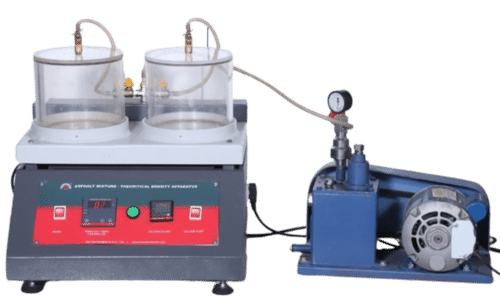
ASPHALT MIXER-THEORETICAL DENSITY METER-WITH VACUUM PUMP About
Applications
This equipment is used for determination of theoretical density of asphalt mixer by vacuum method for application such as asphalt mixer design, road condition investigation, calculation of porosity and compactness in road construction quality management.
Furtherdetails available on our website.
Price and specificationsmentioned here are subject to change as per the application, customerrequirements and prevailing market conditions. Please refer to us for the finalrates and offer.
Precision in Asphalt TestingThis density meter ensures meticulous measurement with an accuracy of 0.01 g/cm and a resolution of 0.001 g/cm. Ideal for obtaining the theoretical maximum specific gravity of asphalt, it supports specimen sizes between 10004000 g and features a standard 5-liter flask capacity. This optimal precision directly supports quality control in pavement construction.
Durable and User-Friendly ConstructionCrafted from corrosion-resistant metals and high-grade polycarbonate, the device withstands rigorous laboratory use. Heavy-duty borosilicate glass flasks and chemical-resistant rubber gaskets further enhance longevity. Fine vacuum adjustment, a clear viewing chamber, and overload protection make operation safe and straightforward for all users.
Compliant and Versatile OperationMeeting international standards ASTM D2041 and AASHTO T209, this equipment is a reliable choice for laboratories, exporters, manufacturers, and traders within India. With both manual and automatic control modes, and a low noise level (<65 dB(A)), it adapts to varied testing environments, ensuring efficient and quiet operation.
FAQs of ASPHALT MIXER-THEORETICAL DENSITY METER-WITH VACUUM PUMP:
Q: How does the theoretical density meter measure the maximum specific gravity of asphalt?
A: The instrument uses a vacuum pump to remove air from a sample of asphalt mix placed in a sealed flask. The resulting measurement, performed as per ASTM D2041 or AASHTO T209, allows for accurate determination of the theoretical maximum specific gravity, essential for quality control in road construction.
Q: What is the typical process for conducting a Rice Test using this device?
A: Begin by placing a representative asphalt sample (10004000 g) into the heavy-duty borosilicate glass flask. After securing the chamber, activate the vacuum pump to reach a vacuum of up to 13.3 kPa, hold for the required period, and monitor the process via the analog gauge. The fine adjustment valve ensures precise vacuum control for consistent results.
Q: When and where should this theoretical density meter be used?
A: This equipment is primarily used in laboratory settings, such as civil engineering labs, quality control facilities, and research institutes. It is suitable whenever there is a need to determine the asphalt mixtures maximum specific gravity, typically during road construction material assessments and routine quality checks.
Q: What are the key benefits of using this instrument for asphalt testing?
A: The meter provides highly accurate and reproducible results, critical for evaluating asphalt compaction and performance. Its robust construction, integrated vacuum pump, and simple manual or automatic controls make it efficient, safe, and long-lasting, directly improving the reliability of test outcomes and aiding in compliance with industry standards.
Q: How many samples can be tested at one time, and what is the specimen capacity?
A: The device is designed to test one specimen per cycle, with each test accommodating a sample size typically ranging from 1000 to 4000 g. The flask has a total capacity of 5 liters, providing ample space for thorough testing as specified by relevant standards.
Q: What included accessories support the operation of the density meter?
A: The package includes a desiccator, vacuum hoses, a release valve, and a removable vacuum gauge. These components facilitate accurate testing, efficient vacuum application, and easy maintenance, ensuring smooth day-to-day operations in the lab.
 Call Us : 08045477242









 Send Inquiry

 Send Inquiry
 Send Inquiry
 Send SMS
 Call Me Free