JOMNEY END QUENCH APPARATUS WITH FURNACE About
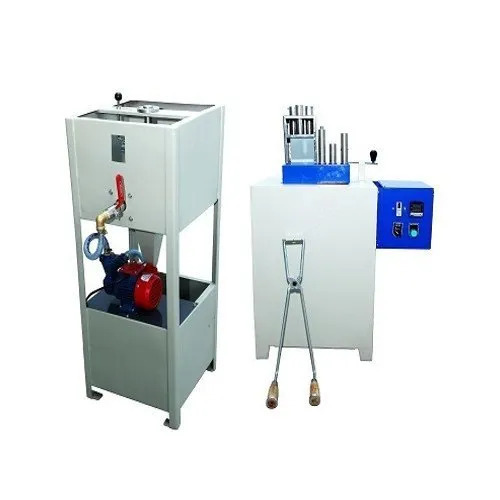
- The equipment consist of Fast heating special Furnace with precisiontemperature control.
- Jominey Test Fixture with in built pumping system.
THE FAST HEATING FURNACE WILL HAVE FOLLOWING
FEATURES
- Temperature is Maximum 1200 degree with a workingtemperature 1000 degree
- LiningCeramic Fiber type with low thermalmass.
- Heatingelements is A1.
Furtherdetails available on our website.
The Price mentioned here are subject to change as per the capacity,specifications and application of the user.
Precision Heating and QuenchingEquipped with a fast-heating electric resistance muffle furnace, the JOMNEY apparatus ensures rapid and uniform temperature elevation for steel specimens. The digital PID controller provides highly accurate temperature regulation, maintaining stability up to 900C. Combined with a motorized jet quenching system, this apparatus facilitates controlled and repeatable metallurgical testing, ensuring reliable results in each experiment.
Robust Construction and SafetyManufactured from powder-coated mild steel, this apparatus offers exceptional durability for daily laboratory use. Safety is paramount, featuring over-temperature cut-off mechanisms and proper earthing to protect both user and equipment. The heat-resistant specimen holder and continuous, adjustable water cooling further safeguard testing integrity and user safety.
Universal Lab ApplicationThis bench-top, semi-automatic apparatus meets IS 3848 and ASTM A255 standards, making it suitable for industrial labs, research institutions, and educational facilities. Its intuitive controls, digital/analog displays, and automated features streamline the process of assessing steel hardenability, providing valuable insight into material properties for a range of metallurgical applications.
FAQs of JOMNEY END QUENCH APPARATUS WITH FURNACE:
Q: How does the JOMNEY END QUENCH APPARATUS operate during a hardenability test?
A: The apparatus heats a steel specimen in its electric resistance muffle furnace to the desired temperature using a digital PID controller. After reaching the target temperature, the specimen is transferred to the quenching station, where a motorized water jet cools it rapidly and uniformly. The resulting hardness profile is then measured along the specimens length.
Q: What types of specimens can be tested with this apparatus?
A: The standard specimen size for this apparatus is 25 mm in diameter and 100 mm in length. The equipment is designed for single-specimen testing in accordance with IS 3848 and ASTM A255 standards, making it ideal for metallurgical analyses of steel.
Q: When should the apparatuss safety features be checked?
A: Safety features like the over-temperature cut-off and earthing should be checked before each session. Regular inspections and functional tests help maintain safe operation and protect both the equipment and operator from potential hazards.
Q: Where is the JOMNEY END QUENCH APPARATUS typically used?
A: This apparatus is primarily used in metallurgical laboratories, research centers, educational institutions, and industrial quality control labs. Its construction and compliance features make it suitable for both academic training and rigorous industrial standards.
Q: What is the process for adjusting cooling water flow during a test?
A: The continuous cooling water supply features an adjustable flow control valve, allowing precise regulation for optimal quenching conditions. Adjustments are made manually on the control interface before the water jet is engaged.
Q: How does the apparatus benefit metallurgical investigations?
A: By enabling controlled, reproducible hardenability testing and rapid hardness profiling along steel specimens, the apparatus assists in evaluating steel grade suitability for various industrial applications. Its precision and compliance with international standards add credibility to research and quality assurance outcomes.
Q: What are the main advantages of the digital PID temperature controller?
A: The digital PID temperature controller offers 2C accuracy, quick temperature response, and stable set-point maintenance up to 900C. This ensures that specimens are consistently heated to the required temperatures, reducing uncertainty in test results.
 Call Us : 08045477242









 Send Inquiry

 Send Inquiry
 Send Inquiry
 Send SMS