CONCRETE PERMEABILITY TESTER - 6 CELL - COMPACT About
IS 516 (Part 2/Sec1): 2018 | BS EN 12390 (Part-8), ISO 7031, UNI 9533
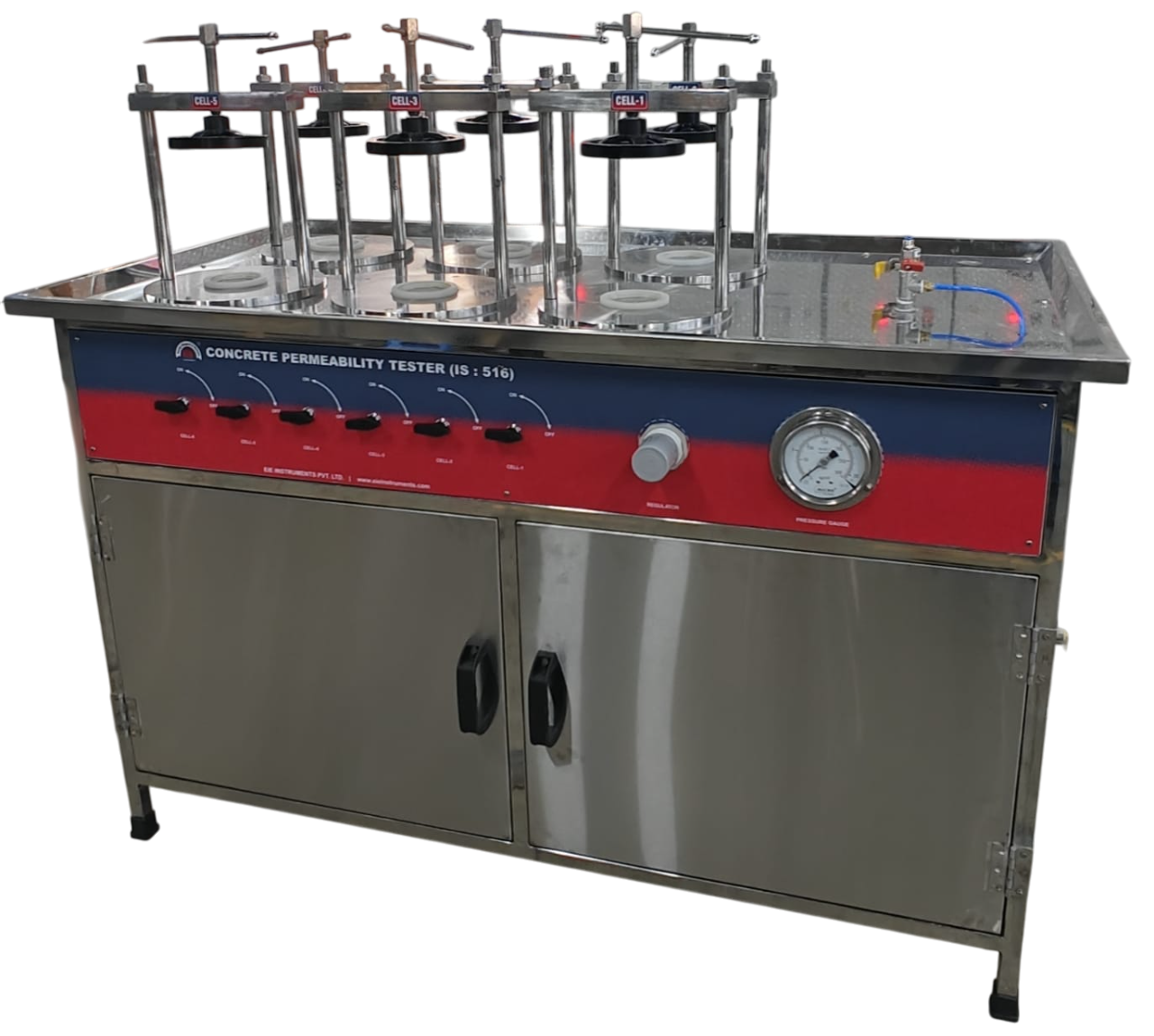
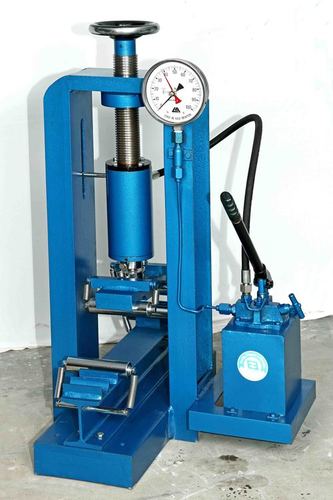
Concrete Impermeability Apparatus consists of a chamber where the concrete sample is placed, and pressure is applied to force water or other fluids through the concrete.
Further details available on our website.
Price and specifications mentioned here are subject to change as per the application, customer requirements and prevailing market conditions. Please refer to us for the final rates and offer.
Precision Permeability Testing Made SimpleEquipped with six independent cells, our compact concrete permeability tester enables simultaneous assessment of multiple cylindrical specimens. Designed with a corrosion-resistant, powder-coated mild steel body, this system guarantees durability and consistent results. The analog pressure gauge and manual operation ensure accurate control as per test standards, making it ideal for both research and routine quality control in construction material labs.
Built for Laboratory Excellence and PortabilityThe testers compact, bench-top design and integrated carrying handles facilitate easy movement between workstations. With its safety pressure relief valve and robust construction, you can rely on this equipment even under demanding laboratory schedules. The water tanks 10-liter capacity is suitable for overnight or multi-day testing, as typically required by IS 3085, while the industrial blue finish resists wear in busy environments.
FAQs of CONCRETE PERMEABILITY TESTER - 6 CELL - COMPACT:
Q: How does the concrete permeability tester operate?
A: This tester operates by applying water pressureup to 5 kg/cmon up to six concrete specimens. Each cell is individually controlled with dedicated valves and securely sealed using rubber O-rings and clamps. The pressure is monitored via an analog gauge, and water permeability is measured according to IS 3085 or ASTM C1202 standards.
Q: What types of concrete samples are compatible with this tester?
A: The machine is designed for cylindrical concrete specimens measuring 150 mm in diameter and 150 mm in height. Samples must be prepared separately, as they are not included with the tester.
Q: When should standard laboratory conditions be maintained during testing?
A: It is essential to test within standard laboratory conditions, specifically temperatures between 5C and 45C and controlled humidity, to ensure accurate and repeatable results as stipulated by IS 3085.
Q: Where should the permeability tester be installed or used?
A: This device is intended for bench-top use in laboratory settings, allowing portability with its carrying handles, but should always be operated in a dry, level area that complies with standard laboratory conditions.
Q: What is the typical duration and process of a permeability test?
A: A standard test, as per IS 3085, typically runs for 48 hours. During this period, water pressure is applied continuously, and the volume of water passing through the specimen is measured manually using the analog gauge provided.
Q: How does the tester benefit laboratory concrete analysis?
A: By enabling accurate, simultaneous testing of six specimens, this tester increases sample throughput, supports strict compliance with international standards, and delivers high-precision results (2% accuracy). Its sturdy, corrosion-resistant construction also ensures long-term reliability.
 Call Us : 08045477242









 Send Inquiry

 Send Inquiry
 Send Inquiry
 Send SMS
 Call Me Free