 Call Us : 08045477242


|
Operating Principle:
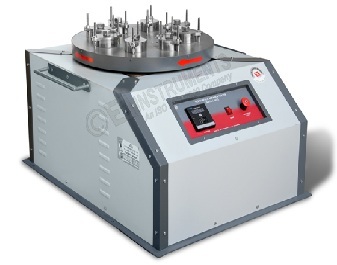
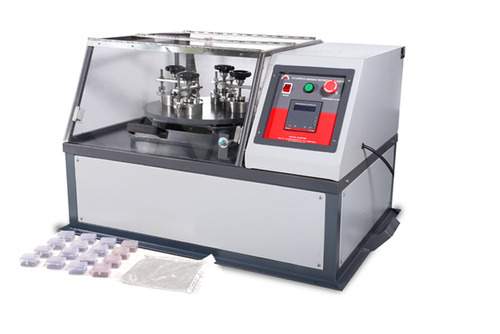
The ability of glazed tiles to resist surface abrasion encountered in everyday use is determined by abrading the glazed surface either with a wet abrasive media consisting of steel balls of 1 to 5 mm diameter, aluminum oxide abrasive powder, and distilled water; or with a dry abrasive media consisting of porcelain cylinders and Aluminum Oxide Abrasive Powder.
The test is conducted by holding a number of test specimens on a flat horizontal disc. The disc is rotated at a speed of 300 rpm with the axis of rotation 22.5 mm out. This causes the abrasive load placed above the test specimen to rub over the surface of test specimen in a circle of 45 cm diameter.The abrasive load is kept in place over the test surface inside a rubber lined cylindrical metallic ring. The ring also keeps the test specimen firmly pressed against the metallic disc.
Further details availableon our website.
The Price mentioned here are subject to change as per the capacity,specifications and application of the user.
Technical Details 

Price:
Minimum Order Quantity : 1 Piece
Voltage : 230 Volt (v)
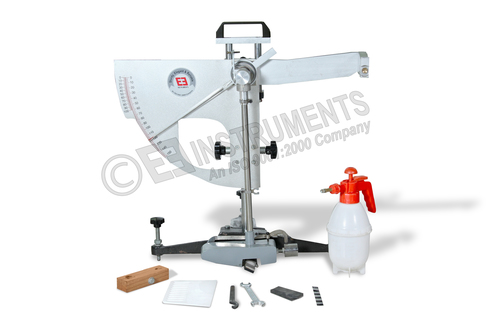
Product Type : Skid Resistance Tester
Application : The instrument is used to measure the resistance value of the asphalt pavement marking, stone, or other material (specimen) and to assess antisliding ability of the road and the road surface material (specimen) in wet or humid conditions. Used to determine friction coefficient on flat, cambered or gradient road surface like highway pavement, city road pavement, airport track.
Automation Grade : Semi Automatic
Features : Accurate results, Robust construction, Efficient working
Minimum Order Quantity : 1 Piece
Voltage : 230 Volt (v)
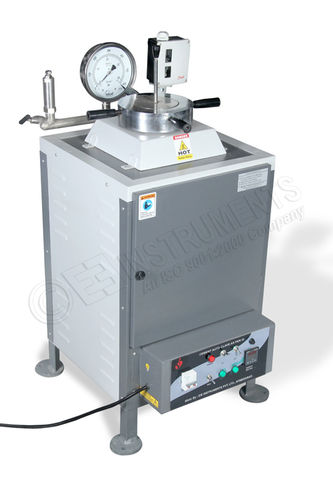
Product Type : Tiles and Ceramics Testing Machine
Application : Triple safety against accidental over pressure. Safety Valve / Pressure control switch/ Digital Temp. indicator cum controller
Automation Grade : Semi Automatic
Features : Accurate results, Robust construction, Efficient working
Minimum Order Quantity : 1 Piece
Voltage : 230 Volt (v)
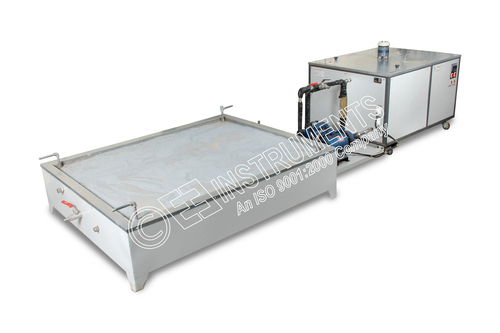
Product Type : DETERMINATION OF RESISTANCE TO THERMAL SHOCK
Application : Determination of resistance to thermal shock of a whole tile by cycling 10 times between the temperatures of cold water and a temperature just above that of boiling water. Usually tests are carried out between 15 C and 145 C.
Automation Grade : Semi Automatic
Features : Accurate results, Robust construction, Efficient working
Minimum Order Quantity : 1 Piece
Voltage : 230 Volt (v)
Product Type : Abrasion Testing Machine for Glazed Tiles
Application : The ability of glazed tiles to resist surface abrasion encountered in everyday use is determined by abrading the glazed surface either with a wet abrasive media consisting of steel balls of 1 to 5 mm diameter, aluminum oxide abrasive powder, and distilled water; or with a dry abrasive media consisting of porcelain cylinders and Aluminum Oxide Abrasive Powder.
Automation Grade : Semi Automatic
Features : Accurate results, Robust construction, Efficient working

 |
EIE INSTRUMENTS PVT. LTD.
All Rights Reserved.(Terms of Use) Developed and Managed by Infocom Network Private Limited. |





 Send Inquiry

 Send Inquiry
 Send Inquiry
 Send SMS
 Call Me Free