PARTICLE CHARGE TESTER About
Applications:
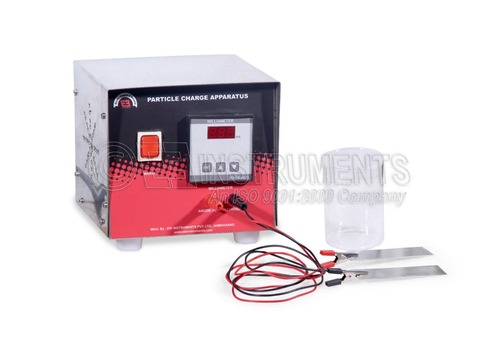
Used to determine the particle charge of Bitumen Emulsion.
Apparatus Details:
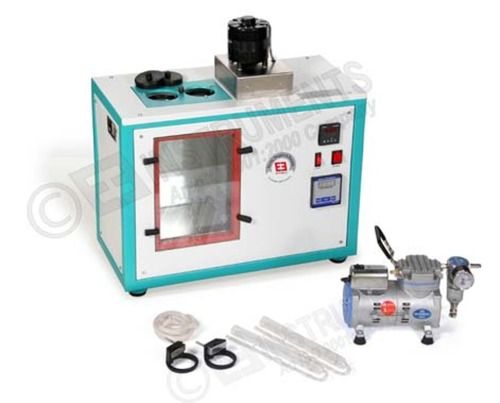
- The equipment comprises of following items
- Digital Milliammeter scale up to 10 mA in front facing control panel
- In built variable resistor circuit
- Beaker 250 ml
- Two stainless steel electrodes
- Insulating device
- Glass rod
- Dimensions : 200 x 200 x 600mm
Further details availableon our website.
The Price mentioned here are subject to change as per the capacity,specifications and application of the user.
Efficient Particle Charge Analysis for Bitumen EmulsionDesigned for laboratory and industrial applications, the PARTICLE CHARGE TESTER enables fast and reliable determination of particle charge in bitumen emulsions. Its durable construction, accurate measurement (1% of reading), and ease of use make it a preferred choice for quality assurance and research. The included borosilicate glass beaker and sturdy mild steel support guarantee performance even under rigorous use.
Precision, Durability, and Safe OperationThis instrument is equipped with manual control and an analog display for straightforward operation. The stainless steel/tinned copper electrodes and powder-coated body ensure both longevity and chemical resistance. Capable of heating up to 150C and powered by a 220V AC supply, it provides stable performance for each test, delivering accurate results necessary for quality control in bitumen and emulsion processing.
FAQs of PARTICLE CHARGE TESTER:
Q: How is the PARTICLE CHARGE TESTER used in bitumen emulsion testing?
A: The tester is utilized to determine the particle charge (cationic or anionic) of bitumen emulsions. This helps assess emulsion properties and predict behavior during road construction or repair. The glass jar is filled with the emulsion sample, electrodes are inserted, and the device performs the charge determination by observing the particle migration under an electric field.
Q: What materials are used in the construction of the PARTICLE CHARGE TESTER?
A: The main body of the equipment is manufactured from powder-coated mild steel, while the 1-liter beaker is made from borosilicate glass for excellent thermal and chemical resistance. Electrodes are crafted from stainless steel or tinned copper to ensure longevity and consistent results.
Q: When should the particle charge of a bitumen emulsion be tested?
A: Testing is typically conducted during production, quality control, and research to verify that the emulsion meets required specifications. It is essential when developing new emulsions or confirming batch-to-batch consistency for construction projects.
Q: Where can the PARTICLE CHARGE TESTER be mounted and used?
A: The tester is designed for bench-top mounting, making it ideal for laboratories, research institutions, and quality control setups in the bitumen and construction industry. Its compact rectangular shape allows it to fit comfortably onto standard lab benches.
Q: What is the process of conducting a particle charge test using this equipment?
A: Place the bitumen emulsion sample into the borosilicate glass beaker, insert the provided electrodes, and set the heating as necessary (up to 150C). With the manual controls and analog display, users monitor the movement of particles under an applied electric field to determine their charge.
Q: What are the key benefits of using the PARTICLE CHARGE TESTER?
A: This equipment offers high accuracy (1% of reading), robust build quality, temperature resistance up to 150C, and ease of use. It helps ensure consistent emulsion performance, supporting efficient pavement construction and maintenance.
 Call Us : 08045477242









 Send Inquiry

 Send Inquiry
 Send Inquiry
 Send SMS