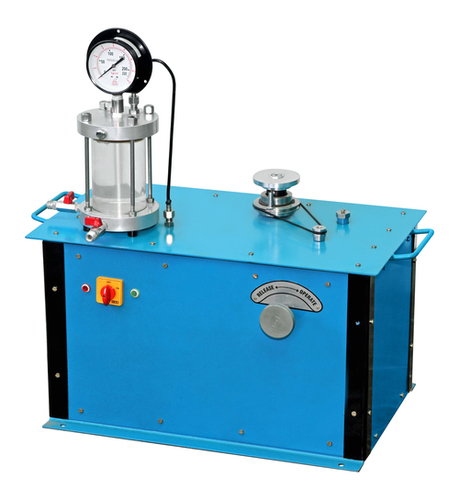
Constant Pressure System (Oil Water) - For Triaxial Test Apparatus About
Specifications
- Range 0-20 bar (0-20 Kg/Cm)
- Steps of pressure 0.5 bar (0.5 Kg/Cm)
- Accuracy + 0.5%,
- Electric Supply 230 Volt, Single phase, 50 Hz, A.C Supply.
- Supplied complete with pressure gauge, flow valves and connecting pressure hose
Note : Price will be change as per specification
Product details
| Voltage | 230 |
| Material | Mild Steel |
| Usage/Application | Soil Testing Equipment |
| Brand | EIE |
| Color | Blue |
| Power Supply | 230 Volt, Single phase, 50 Hz, A.C Supply |
| Country of Origin | Made in India |
Reliable Pressure Accuracy for Geotechnical TestingThe Constant Pressure System delivers accurate pressure control crucial for triaxial testing in soil mechanics. Its fine adjustment mechanism, combined with an electronic regulator, ensures repeatable, consistent measurements. The system maintains pressures up to 10 kg/cm with rapid response and high resolution, providing trustworthy data for researchers and engineers.
Durable Construction and Fluid CompatibilityEngineered with a reservoir of borosilicate glass or stainless steel, the unit is compatible with both deionized water and hydraulic oil. Corrosion-resistant design and sealed construction extend product lifespan and prevent leaks, making the system suitable for rigorous laboratory settings and a diverse range of test fluids.
Advanced Safety and Ease of Use FeaturesPressure relief valves, low fluid level alarms, and IP54 enclosure protection assure operator safety during operation. Integrated handles accommodate easy movement and bench-top mounting simplifies installation. The digital display and optional data logging interfaces facilitate clear monitoring and convenient record-keeping for laboratory personnel.
FAQs of Constant Pressure System (Oil Water) - For Triaxial Test Apparatus:
Q: How does the Constant Pressure System maintain stable pressure during a triaxial test?
A: The system uses a fine adjustment hand wheel and electronic regulator to precisely control and maintain the set pressure on the specimen. Programmable timer functions allow pressure to be held consistently over specific durations, ensuring stable and reliable test conditions.
Q: What types of fluids can be used with this systems reservoir?
A: This system is compatible with both deionized water and hydraulic oil. The reservoir, constructed from borosilicate glass or stainless steel, resists corrosion and supports fluid temperatures up to 60C, accommodating various geotechnical laboratory needs.
Q: When should the pressure relief valve and low fluid level alarm be used?
A: The pressure relief valve provides protection by automatically releasing excess pressure, preventing over-pressurization. The low fluid level alarm alerts operators to refill the reservoir before low levels can disrupt testing, promoting safe laboratory operation.
Q: Where can the system be installed for optimal use?
A: Designed for laboratory environments, the system features a bench-top mounting style and integrated handles for easy transport. Its compact size and sealed construction allow placement in standard laboratory spaces, ensuring convenient access and safe use.
Q: What is the process for connecting the inlet and outlet to the triaxial apparatus?
A: Quick-connect couplings and 1/4 BSP port sizes make connection straightforward. Simply attach both the inlet and outlet hoses to the appropriate couplings, ensuring a secure fit for efficient fluid and gas delivery during testing.
Q: What are the benefits of the digital display and optional data logging?
A: The digital gauge/LED display provides clear, real-time monitoring of test parameters, improving accuracy and ensuring responsive control. Optional RS232/USB interfaces enable direct data logging, simplifying record-keeping and enhancing traceability for laboratory experiments.
Q: How does the system support both manual and automatic pressure control?
A: Users can select between manual adjustment using the hand wheel or automatic control via the electronic regulator. This versatility allows operators to tailor pressure management to the specific requirements of each geotechnical test.
 Call Us : 08045477242









 Send Inquiry

 Send Inquiry
 Send Inquiry
 Send SMS
 Call Me Free