Concrete Cube Vibrating Table About
Application
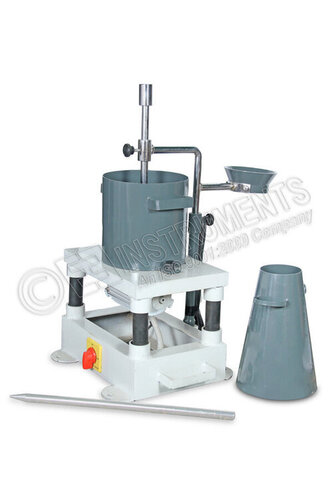
For compaction of concrete cube cylinders.
Also available in wide range of vibrating table variety : 1) 100 x 100 CM 2) 120 x 120 CM 3) 200 x 100 CM 4) 60 x 60 CM 5) 75 x 75 CM and 6) 120 x 150 CM
Construction Details
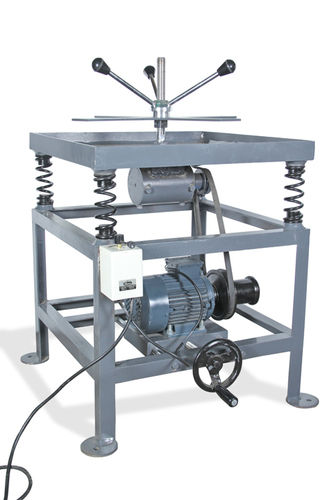
- The Vibrating table is manufactured from Mild Steel material which is powder coated in attractive shades.
- The table deck size has stops along its edges to prevent moulds from walking off the table during operation.
- The variable pitch pulley arrangement permits the frequency to be varied steplessly between maximum of 3600 vibrations down to 2600 vibrations per minute.
- A speed regulation handle is provided for increasing or decreasing the frequency.
- The vibrator is mounted on cushioned steel vibrating deck.
- A switch is provided for turning on the motor.
- Electric motor will be of reputed make such as GE/CROMPTON GREAVES/MARATHON
- Operation on 440 Volts, 50 Hz, three phase, A.C. supply.
- Dimensions : 600 mm x 600 mm
Further details availableon our website.
The Price mentioned here are subject to change as per the capacity,specifications and application of the user.
Precision in Concrete TestingOur Concrete Cube Vibrating Table is engineered to deliver uniform compaction of concrete specimens, making it an essential tool for laboratories and construction quality control. By minimizing the presence of air gaps and inconsistencies, the table ensures that each sample is prepared under optimal conditions for reliable compressive strength testing.
Robust Power and Adaptable PerformanceConfigured for a 440 Volts, 50 Hz, three-phase A.C. supply, the vibrating table accommodates a range of operational environments. Its adjustable vibration rate, from 3600 to 2600 vibrations per minute, supports different concrete mixes and testing needs, offering flexibility and control to users in demanding settings.
FAQs of Concrete Cube Vibrating Table:
Q: How is the Concrete Cube Vibrating Table operated?
A: The table is powered by a 440 Volt, 50 Hz, three-phase A.C. supply. Simply connect the unit to the appropriate power source, place the concrete cube or cylinder specimens on the table, and activate the unit to begin the vibration process for compaction.
Q: What is the main purpose of using a vibrating table in concrete testing?
A: Its primary function is to compact concrete cubes and cylinders to eliminate air pockets and ensure uniform density, which is crucial for accurate testing of compressive strength and overall quality assurance.
Q: When should the vibrating table be used during concrete testing?
A: Use the vibrating table immediately after pouring fresh concrete into molds. Compaction should occur before the concrete begins to set, ensuring that trapped air is removed for a sample that truly represents the mixs performance.
Q: Where can this vibrating table be installed and used?
A: The vibrating table is suitable for installation in laboratories, construction sites, and research facilities. Its designed for stationary placement on stable surfaces where concrete testing is routinely performed.
Q: What is the process for compacting specimens with this vibrating table?
A: After filling the molds with fresh concrete, place them securely on the table. Initiate the vibration process at the recommended speed, typically between 3600 and 2600 vibrations per minute, for the required duration to achieve proper compaction.
Q: How does the vibrating table benefit concrete testing processes?
A: By providing uniform and efficient compaction, the vibrating table significantly reduces variability in sample density and compressive strength results, leading to more reliable and accurate testing outcomes.
Technical Details 
 Call Us : 08045477242










 Send Inquiry

 Send Inquiry
 Send Inquiry
 Send SMS
 Call Me Free