About ASSEMBLY OF APPARATUS FOR DETERMINATION OF CARBONATE
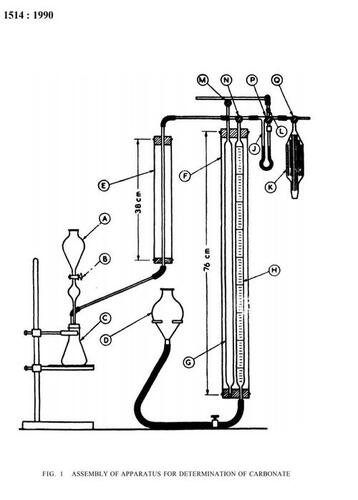
ASSEMBLY OF APPARATUS FOR DETERMINATION OF CARBONATE IN LIME
Furtherdetails available on our website.
The Price mentioned here are subject to change as per the capacity,specifications and application of the user.
Exceptional Materials and ConstructionCrafted from premium borosilicate glass and acid-resistant rubber, this apparatus ensures durability and resistance to aggressive reagents. Each component is designed for easy disassembly and thorough cleaning, which maintains the integrity of your analyses over repeated use. Transparency in construction assists in real-time observation and simplifies maintenance procedures.
Precise and Manual Carbonate AnalysisEngineered for accuracy, the assembly features a 50 ml graduated burette and a 100 ml flat-bottomed flask, enabling immediate and visual measurements of carbonate content. The manual control mode allows for a hands-on, precise analysis ideal for laboratory settings where power supply may be limited or unavailable, supporting rigorous determinations conforming to Indian and ASTM standards.
User-Friendly and Versatile ApplicationBuilt for laboratories, exporters, manufacturers, and research institutions, this equipment accommodates single samples of powdered material ranging from 1-2 grams. Its standard glass connectors, manual operation, and direct absorption gas collection make routine analysis straightforward and efficient, while the robust design ensures compatibility with common carbonate analysis reagents.
FAQs of ASSEMBLY OF APPARATUS FOR DETERMINATION OF CARBONATE:
Q: How is the Assembly of Apparatus for Determination of Carbonate used in lime and cement analysis?
A: The apparatus enables manual determination of carbonate content by introducing a powdered sample into the reaction flask, adding reagents, and capturing the produced gas for quantification using the graduated burette and absorption tower. This visual, manual approach ensures immediate results and accurate measurements.
Q: What materials are used in the construction of the apparatus, and why are they important?
A: It is constructed from borosilicate glass and acid-resistant rubber, offering excellent resistance to chemical corrosion and high thermal shock, ensuring reliable performance during exposure to standard carbonate analysis reagents.
Q: When should the apparatus be cleaned, and how?
A: The apparatus should be cleaned thoroughly after each analysis. It can be dismantled easily, and all washable parts should be rinsed with appropriate solvents and water to prevent reagent residue buildup and maintain measurement accuracy.
Q: Where can this apparatus be effectively used?
A: This assembly is suitable for laboratory bench-top use in industrial, educational, research, and quality control environmentsespecially where manual, power-free carbonate testing is required for lime or cement samples.
Q: What are the key benefits of using this carbonate determination apparatus?
A: Benefits include high chemical compatibility, durable leak-proof design, easy assembly and cleaning, precise manual measurements, and compliance with IS 6932 (Part VI) and ASTM C25 standards, making it ideal for reliable routine testing.
Q: What is the measuring range and accuracy of the apparatus?
A: The equipment measures carbonate content from 0% to 100% with a high accuracy of 0.5% and a resolution of 0.01%, making it suitable for both low and high concentration analyses.
Q: How many samples can be analyzed per run, and what is the recommended specimen size?
A: The assembly is designed for single-sample analysis per run, with recommended powdered specimens of 1-2 grams to ensure optimal reaction efficiency and measurement accuracy.
 Call Us : 08045477242









 Send Inquiry

 Send Inquiry
 Send Inquiry
 Send SMS
 Call Me Free