About Petroleum Testing Equipments
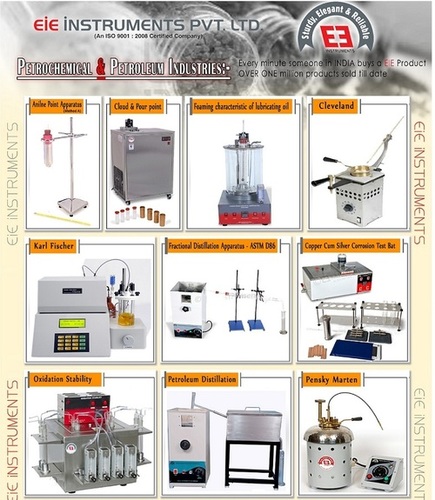
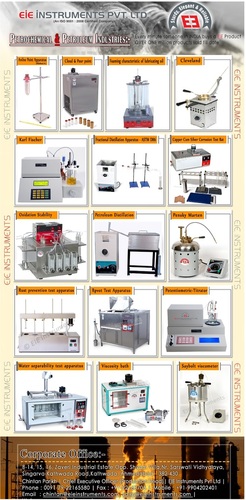
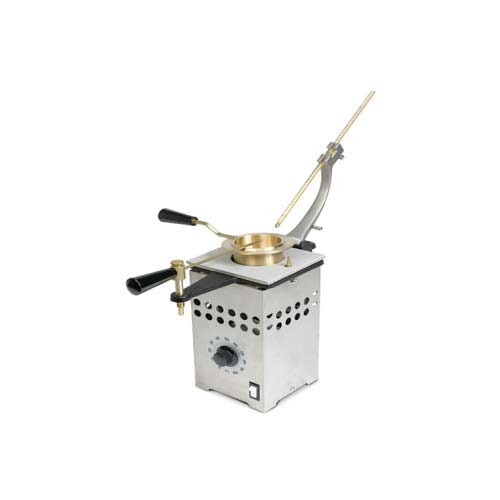
Use our modern and precised qualitative Petroleum Testing Equipments. These are made from high grade stainless steel to make them corrosion resistance and durable in quality. They consumes less of power supply and need minimum maintenance service. The testing equipments are designed in compact shape with accurate dimension. Are known as four hour test period which are used for measuring the rust prevention capacity of oils and fuels. Additionaly, testing equipments include viscosity baths, water separability and rpvot test apparatus. Petroleum Testing Equipments provides 100% precised reading in three to four digit. These are easy to clean and maintain.
Features:
1) Have easy and simple automatic function.
2) Compact size and manufactured in floor mounted style.
3) Provides 100% accurate and precised reading values for oils and fuels.
4) User friendly and durable in quality.
Optimized for Industrial UseEngineered for rigorous usage in petroleum industries, these testing equipments handle continuous, high-demand environments, ensuring consistency and reliability throughout various applications. With a resilient build and multi-functional interface, they offer long-term operational stability.
Easy Integration & Versatile Power SupplyThe equipments support 220/240 Volt, 50 Hz, single-phase AC supply, simplifying installation and integration with existing industrial setups. Whether you operate a laboratory or a complex refinery, the adaptable power configuration ensures flawless functionality.
FAQs of Petroleum Testing Equipments:
Q: How do I properly use Petroleum Testing Equipments in an industrial setup?
A: To use the equipments effectively, connect them to a 220/240 Volt, 50 Hz, single phase AC supply, then follow the standard operating procedures provided in the user manual. Proper calibration and adherence to safety guidelines are essential for obtaining accurate test results.
Q: What testing processes can be carried out with these equipments?
A: The equipment is suitable for a wide range of petroleum analysis, including viscosity, flash point, pour point, and distillation of petroleum products. These processes help ensure compliance with industry quality standards.
Q: When should petroleum testing be conducted using this equipment?
A: Petroleum testing should be performed both at the point of production and periodically during storage to verify quality parameters and detect any contamination or degradation over time.
Q: Where are these Petroleum Testing Equipments typically installed?
A: These devices are primarily installed in industrial laboratories, refineries, and manufacturing plants across India. Their robust design also makes them suitable for export and use in similar facilities worldwide.
Q: What are the benefits of using a 450 Watt, 220/240 Volt Petroleum Testing Equipment?
A: With a 450 Watt power rating and flexible voltage options, these equipments provide reliable performance, energy efficiency, and compatibility with standard industrial electrical setups. This ensures uninterrupted, accurate testing for quality assurance.
Q: How does the power supply specification enhance equipment performance?
A: The 220/240 Volts, 50 Hz, single-phase AC power supply delivers stable power, which results in consistent operation and minimizes the risk of electrical failures during critical testing procedures.
 Call Us : 08045477242









 Send Inquiry

 Send Inquiry
 Send Inquiry
 Send SMS
 Call Me Free