DIRECT SHEAR APPARATUS SERVO CONTROLLED BASED WITH SOFTWARE About
Introduction:
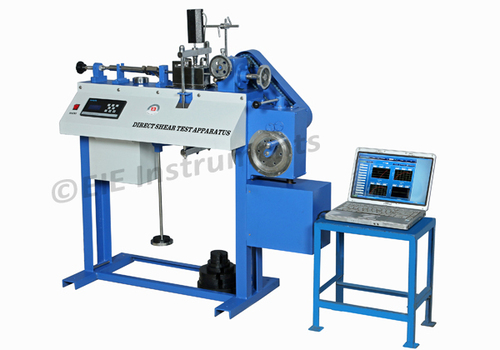
The test covers the determination of consolidated drained or undrained shear strength of a soil material by direct shear. Normal Load, Strain and shearing force are measured directly during the test. Specimen size 60mm square or round can be tested. The complete system consist of Microprocessor based Touch screen operated and controlled Load Frame, Mould assembly or shear box made of brass with accessories, Shear box housing with two ball strips, specimen cutter with set of weights to give normal stress through lever.
Further details availableon our website.
The Price mentioned here are subject to change as per the capacity,specifications and application of the user.
Advanced Servo-Controlled SystemEmploying a high-end servo motor, this apparatus ensures precise and consistent movement during testing. The motors advanced control capabilities allow users to set exact test speeds from as low as 0.00001 mm/min to 9.999 mm/min, while the robust build is ideal for handling demanding soil samples.
Sophisticated Software IntegrationDesigned for seamless compatibility with Windows OS, the integrated software streamlines data acquisition and analysis. Digitally output your results via USB or Bluetooth, export to Excel or PDF, and experience real-time graphing for superior control over every stage of the shear testing process.
Reliable and Safe OperationSafety is prioritized with overload and travel protection features. The apparatus is tailored for lab environments, supporting humidity ranges from 20% to 80% RH and temperatures from 10C to 40C. Its substantial build ensures both stability and safety during comprehensive soil strength analyses.
FAQs of DIRECT SHEAR APPARATUS SERVO CONTROLLED BASED WITH SOFTWARE:
Q: How does the servo-controlled system enhance soil shear testing accuracy?
A: The servo-controlled motor provides meticulous regulation over test speed and displacement, yielding highly repeatable data. Combined with a high-precision LVDT sensor, this enables the determination of shear strength in soils with an accuracy of 0.5% of reading.
Q: What is the process for collecting and analyzing test data with this apparatus?
A: Users can conduct tests via the integrated software on Windows OS, which logs and displays data in real-time. Results are easily exported to Excel or PDF files for further analysis or reporting, streamlining workflow and documentation requirements.
Q: When should this apparatus be used in soil testing?
A: This equipment is essential for testing consolidated drained or undrained shear strength in soils, which is often required in geotechnical investigations, foundation design, and research applications. It is most suitable for laboratory settings where precision and reliability are critical.
Q: Where is the ideal environment to operate the Direct Shear Apparatus?
A: It is designed for indoor laboratory use, functioning optimally at temperatures between 10C40C and humidity levels of 20%80% RH. This ensures accurate and safe performance during soil analysis procedures.
Q: What safety features are integrated into the apparatus?
A: The system incorporates overload protection to prevent damage from excessive forces and travel protection to avoid surpassing mechanical limits. These safeguards help maintain operator safety and equipment integrity during all stages of testing.
Q: How is the equipment controlled and monitored during operation?
A: Control is achieved via user-friendly PC software that provides a digital interface for setting test parameters, monitoring real-time graphs, and logging data. Connectivity is offered through USB or Bluetooth, facilitating straightforward operation and data management.
Q: What are the benefits of using this apparatus for soil testing?
A: This device delivers precision, reliability, efficient data management, and high safety standards. It significantly reduces manual input, speeds up analysis, and offers versatile reporting formats, making it ideal for professional laboratories, exporters, manufacturers, and research institutions.
 Call Us : 08045477242









 Send Inquiry

 Send Inquiry
 Send Inquiry
 Send SMS