Plate Bearing Test Apparatus About
Purpose
These test methods are used to estimate the bearing Capacity of in-situ soil under field loading conditions for a Specific loading plate and depth of embedment. Test methods are also used for load tests of soil and flexible pavement Components for use in evaluation and design of airport and Highway pavements
Further details availableon our website.
The Price mentioned here are subject to change as per the capacity,specifications and application of the user.
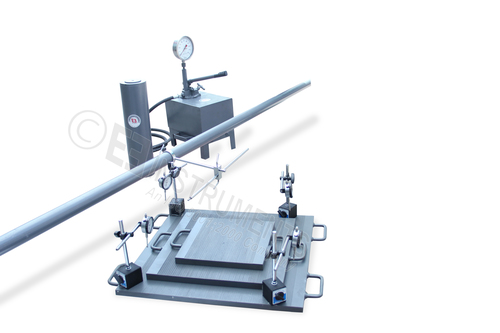
Engineered for Reliable Soil TestingThis Plate Bearing Test Apparatus is meticulously designed to provide accurate analysis of soil bearing capacity and settlement. Its precision dial gauges and hydraulic jack enable engineers and geotechnicians to conduct field tests with high accuracy, ensuring that each measurement reflects true site conditions. The apparatus supports a range of plate sizes and is suitable for use in infrastructure projects across India.
Robust Construction and Standard ComplianceConstructed using a heavy-duty mild steel plate finished with hard chrome plating and powder coating, this apparatus is both durable and corrosion-resistant. Strict adherence to IS:1888 compliance ensures the apparatus meets industry benchmarks for safety and accuracy. Each unit is supplied with a calibration certificate for added reliability in critical testing scenarios.
Portable and Easy to Use on SiteThe compact, ground-mounted design of this apparatus allows for quick assembly and disassembly, making transport and setup straightforward for field teams. Manual/hydraulic control modes, along with instantaneous analog display, facilitate flexible operation under diverse environmental conditionshumidity up to 90% RH, temperatures between 5C and 45C.
FAQs of Plate Bearing Test Apparatus:
Q: How do you use the Plate Bearing Test Apparatus for soil testing?
A: To operate the apparatus, place the mild steel plate on the prepared soil surface and connect the hydraulic jack. The load is applied incrementally using the manual or hydraulic controls while three precision dial gauges measure and record the soils settlement. The process continues until the desired load or maximum settlement is achieved.
Q: What are the main benefits of using this Plate Bearing Test Apparatus?
A: This apparatus delivers high-accuracy results for soil bearing capacity and settlement, meeting IS:1888 standards. Its corrosion-resistant, robust construction ensures longevity, while portable design and instant analog response make it ideal for field use. It improves the reliability of foundation design in civil engineering projects.
Q: When should plate bearing tests be performed on a construction site?
A: Plate bearing tests should be performed before the commencement of any major construction involving foundations. This helps assess the soils bearing capacity and settlement behavior, providing data crucial for safe foundation design and risk prevention.
Q: Where can the Plate Bearing Test Apparatus be used?
A: This apparatus is suitable for use at construction sites, infrastructure projects, and geotechnical investigations across diverse environments in India. Its portable and weather-resistant features make it practical for outdoor field testing under varying temperature and humidity conditions.
Q: What range of plate sizes can be tested with this apparatus?
A: According to IS:1888 standards, the apparatus can accommodate plate sizes of 300 mm, 450 mm, and 600 mm diameter, allowing flexibility for different project and soil conditions.
Q: How accurate are the measurements taken with this equipment?
A: The Plate Bearing Test Apparatus achieves an accuracy of 1%, with resolution up to 0.01 mm, due to its high-precision dial gauges and robust design, ensuring that settlement and bearing capacity measurements are dependable for engineering analysis.
Q: What accessories and certifications are included with the apparatus?
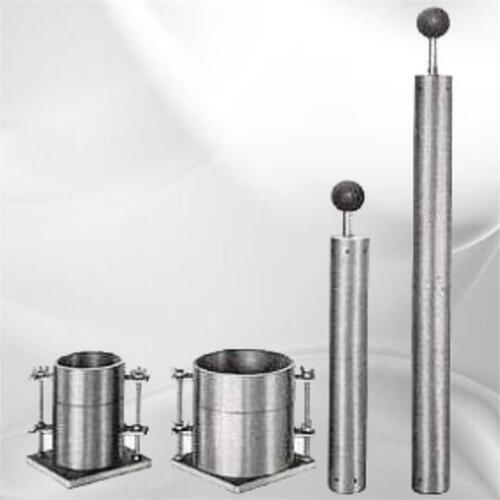
A: Each kit comes with extension rods, a ball and socket joint, a calibration certificate for measurement verification, and a powder-coated finish to protect against rust and environmental damage.
 Call Us : 08045477242









 Send Inquiry

 Send Inquiry
 Send Inquiry
 Send SMS